“Gold Rush” in Bulgaria, or how to spend your next holiday in an exciting way

23 Nov 2021

They say that most of the gold in Bulgaria can be found by walking with a metal detector along the beaches of Varna, Burgas, Sveti Vlas and other Black Sea towns and resorts. But did you know that Bulgaria has a huge number of gold-bearing rivers where, with the help of simple tools, you can pan real gold? If you have already tried every kind of tourism and leisure and don’t know what other interesting thing to do in Bulgaria, Bulgaria Avenue invites you on a journey across Bulgaria in search of gold.
In terms of gold mining, Bulgaria is second in Europe only to Turkey, Finland and Sweden. The largest gold-mining enterprise in Bulgaria, where the bulk of the country’s precious metal is produced, is the Chelopech mine. In 2019, the first new gold mine in a long time was launched at the epithermal Ada Tepe deposit, located 3 km from the town of Krumovgrad. The mine belongs to the Canadian company Dundee Precious Metals. The value of the project is USD 164–166 million.
Is it legal to pan for gold in Bulgaria on your own?
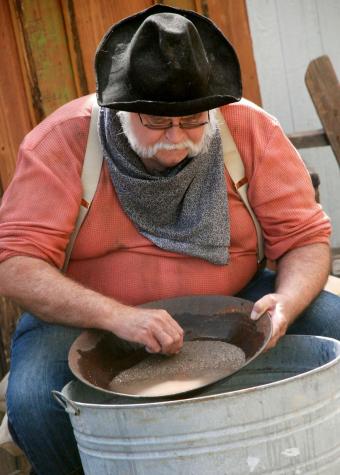 There are around 1,500 people in the country who pan for gold as a hobby and live off it alone. There is even a prospectors’ association — the «Bulgarian Association of Searchers of Native Gold and Meteorites».
Under the Subsurface Resources Act, in Bulgaria you may extract gold from riverbeds by hand (paragraph 1, item 2). Such activity is not regulated by legislation. It is therefore assumed that anyone may pick up their tools and head to some mountain river in search of the precious metal.
Many Bulgarian gold prospectors join communities where they share information about locations and the nuances of extraction. It is believed that without experience and the knowledge of seasoned colleagues you will not find gold, even if you read a thousand books on gold mining.
Still, if you decide to become a gold prospector, it is worth bearing in mind a few restrictions. Extraction is prohibited in coastal river floodplains and on land adjacent to rivers and reservoirs (Subsurface Resources Act, paragraph 1, item 3).
Signs that a river contains gold
Gold has been mined in Bulgaria since ancient times. Many researchers believe that both the famous Varna treasure and Thracian gold originated in Bulgaria. It was found in the rivers descending from the Rhodope, Strandzha and Balkan mountains.
Here are several signs by which you can tell whether or not a river contains gold:
- The presence of the mineral magnetite in the river. You will know it is there if you use a sufficiently strong magnet; it attracts this black mineral.
- The next sign is the presence of quartz. It looks like crystals of transparent, pink or white colour.
- On the stones lying on the riverbed you may notice orange, yellow or rust-coloured spots. The more such stones there are, the higher the probability of finding gold.
- Field horsetail grows near bodies of water. A sure sign is the presence of 50–100 plants growing next to each other. Interestingly, grains of the precious metal can be found even in the plant’s roots.
Even if only one of these signs is present, the probability that the river contains gold is high. But if you have found all four, get ready for real gold mining. Take samples at several points along the same river. Usually there is more gold dust where the water flows without bends, slowly, and the channel widens.
When you set off in search of gold in Bulgaria, don’t forget to take with you:
- A container for the gold dust;
- A sieve, preferably made of light plastic;
- A spade; sometimes it is better if it is foldable;
- A magnet to identify magnetite;
- Tweezers for separating grains of gold;
- A tool for widening and cleaning cracks.
With luck, local gold prospectors find, on average, grains of about 0.5 g of gold per day. Some take the gold home. Others take it to a jeweller to make a souvenir from a treasure found with their own hands. Still others sell it.
Places where you can look for gold in Bulgaria
 Let us note straight away that the poorest rivers are in Varna. This is where the joke comes from that it is better to look for coins on the beach than for gold in a river.
Burgas Region
To the south of Burgas, in the mountain rivers of Strandzha, the chance of finding real gold is higher. The gold-bearing rivers are considered to be:
- Ropotamo – located between Sozopol and Primorsko. But you need to be careful — you should not pan for gold within the Ropotamo reserve itself. It is better to go upstream towards the village of Novo Panicharevo.
- Dyavolska – between Primorsko and Kiten.
- Karaagach – between Kiten and Lozenets.
- Papiysko dere – between Tsarevo and Akhtopol.
- Veleka – in the village of Sinemorets.
- Rezovska – in the village of Rezovo directly next to the border with Turkey.
- Sozopol, Primorsko, Kiten, Varvara and Sinemorets are excellent places for beach holidays, walks and getting to know the ancient culture and history of Bulgaria. You must agree that this is a truly unique opportunity to combine a seaside holiday with a search for gold! Especially given that in these resort towns Bulgaria Avenue can help you buy an apartment for permanent residence or a summer holiday.
To search for gold in the Burgas Region you can also head into the Strandzha mountains. The name is reminiscent of the English «strange». It is said that the person who gave the name saw the unusual colour of the mountains, caused by the minerals, and named them accordingly.
In the Strandzha mountains, modern gold prospectors are drawn to the rivers:
- Rosenska – located next to the village of Rosen.
- Izvorska – between Burgas and the village of Krushevets. The source is in the area of the village of Indzhe Voyvoda.
- Mladezhka – in the village of Mladezhko. It is located on the road from Burgas to Malko Tarnovo. If you go there, don’t forget to visit the local caves and bathe in the mineral-water pools.
- Oryashka – between the villages of Fazanovo, Velika and the resort of Kiten.
- Lopushnitsa – a very small tributary of the Rezovska River, located next to the Uzunbudzhak reserve. Because of the proximity to the reserve, gold prospecting there may be restricted.
Northern Bulgaria
The mountain rivers of northern Bulgaria, in the Balkan mountains, are a paradise for gold prospectors. Among them is the Dalgodelska Ogosta with all its tributaries. The most interesting spots are located next to the villages of Govezhda, Kopilovtsi, Zhelezna and Martinovo.
Along the banks of the tributaries of the Ogosta — the Chiprovska, Zlatitsa and Barziya rivers — lies the town of Chiprovtsi, along with the villages of Chereshovitsa, Gagnitsa, Kostentsi and many others.
Gold is also mined in the area of the Yantra River, though not next to Bulgaria’s world-famous old capital, Veliko Tarnovo, but around the small town of Gabrovo, known for its jokes and humour.
Southern Bulgaria
The next area worth discussing in more detail is Sredna Gora. It is located to the south of the Balkan mountains.
Few people know it, but even in the districts of the modern Bulgarian capital, Sofia, you can look for gold. The Iskar and Struma rivers and their tributaries, flowing in the area of Vitosha, in the Knyazhevo, Simeonovo and Dragalevtsi districts and in the villages of Pancharevo and Bistritsa, are excellent for such an adventure. It is also hard for gold prospectors to overlook the Tundzha River and its tributaries. On this river stands the town of Kazanlak, famous for its rose fields and its huge number of Thracian royal tombs. Nearby are the village of Koprinka, the Elatsite mine, Tsar Asen and the Radka mine.
Gold is found on the Stara Reka River near Kazanlak and in small rivers around the town of Chirpan and the village of Kolyo Marinovo.
The Kyustendil Region is of interest to gold prospectors. The richest gold-bearing rivers are:
- Dragovishtitsa – to the north of the town of Kyustendil.
- Bistritsa – next to the villages of Garlyano, Dolno Selo and Rasovo.
- Treklyanska – in the area of the villages of Treklyano, Dobri Dol and Sredorek.
The Rila–Rhodope region
An area of unique beauty, formed by two mountain ranges — Rila and the Rhodopes. Here you will find ski resorts, old monasteries and wineries producing very tasty wine.
It is said that every river here contains gold. Let us note the following:
- The Vacha River in the western Rhodopes with its tributaries Devinska, Shirokolashka, Karadzhadere and Gashnya. Nearby are the town of Devin and the villages of Shiroka Laka and Dospat.
- The Arda River with its tributaries Krumovitsa, Varbitsa, Bela and Kesibir. The nearby settlements are Kardzhali, Madzharovo, Momchilgrad, Zlatograd, Ivaylovgrad, Rudozem and the villages of Smilyan and Srednogortsi.
In almost every region of Bulgaria you can find a gold-bearing river. With Bulgaria Avenue you will not only become the owner of a wonderful property, but you will also be able to find a new hobby for yourself and perhaps even grow rich from mining gold.
Subscribe to real estate market news
Get weekly analytics and current offers.